

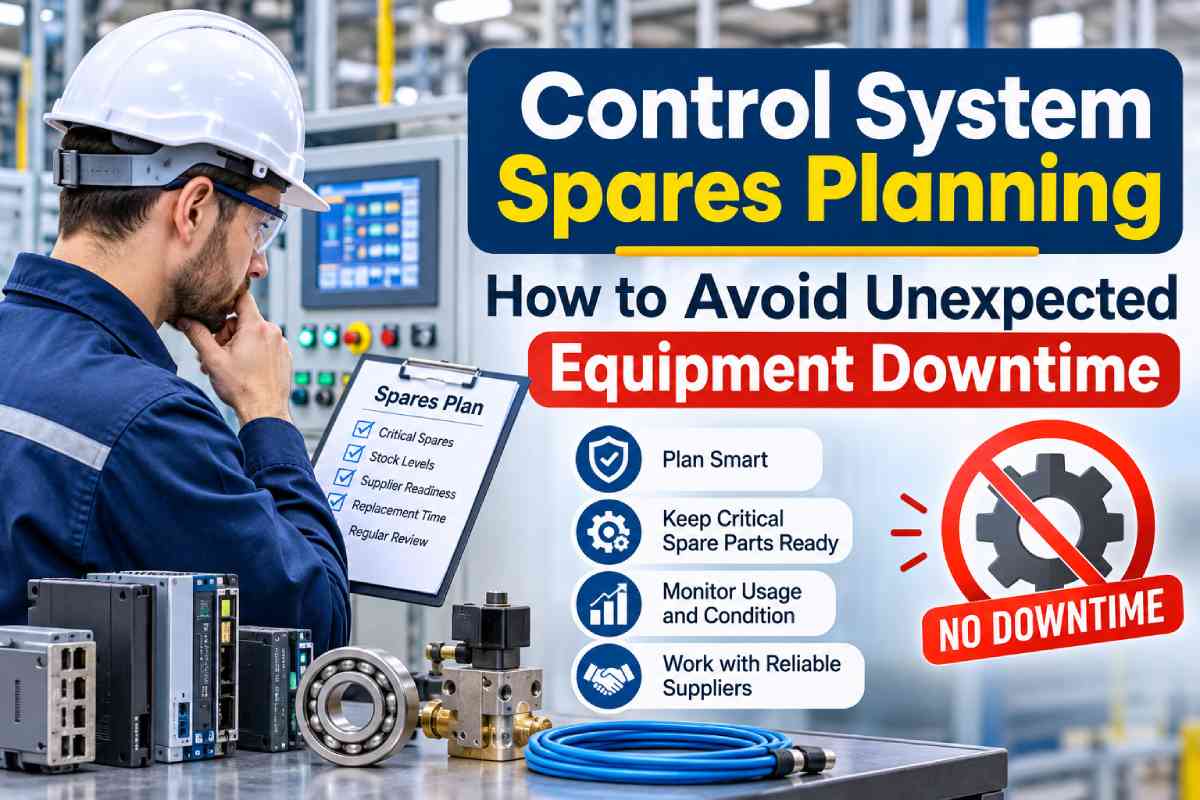
It’s 2:00 p.m. Production is running smoothly, the day’s targets are within reach, and the maintenance team finally has a moment to breathe. Then an alarm flashes. A control module has failed, and the entire production line comes to a halt.
No immediate replacement. No quick fix. Just a growing list of delayed orders and someone frantically searching through supplier catalogs. It’s an industrial maintenance nightmare, but one that better planning can often prevent.
Effective control system spares planning is about preparing for equipment failures before they happen. That means identifying critical components, understanding replacement lead times, and knowing where to source or repair parts when something goes wrong. Easier said than done? Not really, provided you approach inventory strategically.
Table of Contents
1. Identify Your Most Dangerous Spare Parts
Here’s a mistake many facilities make: treating every spare component as equally important. Some parts are inexpensive and readily available. Others are essential to keeping production running and can take weeks to replace. It’s the latter we should really be focussing on.
Have a look at your industrial control systems and see which components you would have disruption to if something were to go wrong. This could include:
- PLC processors & communications modules
- Power supplies & I/O modules
- Industrial drives & control boards
- Sensors, relays, and interface cards
- And other vital automation components
Not all components will be based around cost to buy. Think about what would happen if they went down, how easy they would be to replace and how quickly you can get production back online. A cheap PLC module could be far more important to keep in stock if it has a long lead time to order, than an expensive part that is available from several sources.
2. Let Your Equipment’s History Do the Talking
If the same component has failed three times in two years, that’s probably worth investigating.
Maintenance records offer valuable clues about which spare parts your facility actually needs. Breakdowns can be reviewed, how often replacements were required, what issues come up repeatedly and what equipment is always causing issues.
Your maintenance technicians will also have insight into what parts are causing issues, what models are hard to get hold of and what small issues cause disruption. This combined with your maintenance logs will help you to create realistic priorities for your inventory.
These should be reviewed on a regular basis. The equipment will change, the production requirements will change and what was a vital spare part may no longer be needed due to an automation upgrade.
3. Stock Smart, Not Excessively
There’s a temptation to solve every potential parts shortage by buying more inventory. Understandable, perhaps. Financially sensible? Not always.
Overstocking will tie up your capital, take up space and increase the risk of parts becoming obsolete. A better way to manage this would be to group them based on their criticality and how easy they are to replace.
Highly critical items which have a long lead time may make sense to keep stock of. Items that are less critical and easy to get can often be ordered when needed.
Older automation devices should be considered. Some models may have been discontinued by manufacturers but still be used in industrial environments for years. Not knowing if they are available until they fail is risky.
4. Have a Backup Plan for Hard-to-Find Components
Sometimes no matter how well planned your inventory is, you can find that you have a failed PLC module and the manufacturer no longer stocks it.
What do you do? Before you think about replacing your system at great cost, look into having your component professionally repaired. It is often possible to repair an industrial electronic component.
Obviously not everything can be repaired but depending on the condition of the component, the parts available and technical requirements, it may make financial sense.
This is where a repair company comes in handy. Classic Automation can help businesses looking for solutions to their industrial automation repairs and sourcing issues. By identifying a specialist for your repairs, you now have an option for your maintenance teams if they find they cannot get hold of essential control system components.
5. Make Sure Your Spare Parts Are Actually Findable
A spare part can be difficult to find in an overcrowded store room. Maintain some form of logging system with details of what models are in stock, quantity, location, compatibility and supplier. Set some minimum levels so you know when you need to order more of the vital parts.
Ensure that someone is responsible for checking your stock. This will avoid the problem of the replacement parts getting lost within maintenance.
The storage conditions should also be considered. Some electronic parts may require a dry, dust free area to protect them from electrostatic build up and extreme temperatures. Ensure that you follow the manufacturer’s recommendation to avoid causing damage to your equipment whilst it is in storage.
Prepare Today, Avoid the Panic Tomorrow
Control system spares planning isn’t about filling shelves with every component imaginable. It’s about understanding which failures pose the greatest risks and making sure your facility has a realistic response.
Review maintenance history, prioritize critical inventory, monitor obsolete equipment, and establish relationships with reliable repair and sourcing providers.
Equipment failures are sometimes unavoidable. Spending days searching for a replacement part that could have been identified and sourced in advance is a different story. And that’s one production problem worth solving before the alarm starts flashing.
Also Read: What is Web Traffic? – What are the Types, 6 Key Factors, and More
