
Table of Contents
Why Repurposing Long-Form Video Is the Highest-ROI Content Strategy in 2026
Publishing a single 45-minute YouTube video or podcast episode and leaving it on one platform leaves over 80% of its potential reach untapped. In 2026, short-form discovery engines—TikTok, Instagram Reels, and YouTube Shorts—operate primarily as interest-graph search engines rather than follower feeds.
However, simply chopping a 16:9 horizontal video into random 60-second vertical segments no longer works. Viewer retention standards have tightened, and both social algorithms and AI search crawlers evaluate content based on watch-time velocity, semantic clarity, and visual engagement.
To consistently generate viral short-form assets from long-form recordings, creators and marketers rely on a repeatable, AI-assisted four-step production pipeline.
The 4-Step 2026 Video Repurposing Workflow
Step 1: Semantic Hook Extraction (Finding the “Micro-Stories”)
A viral short is not a trailer for your long video; it is a self-contained micro-story with a clear beginning, middle, and payoff. Instead of scrubbing through timelines manually, start with transcript-based analysis:
- Identify Emotional & Informational Peaks: Look for contrarian takes, step-by-step frameworks, or high-energy storytelling moments lasting 25 to 55 seconds.
- Isolate the First 3 Seconds: If the extracted segment starts with “So, as I was saying earlier…”, cut it. Reorder the clip so the boldest claim or most intriguing question lands in frame one.
Step 2: Intelligent Vertical Framing & Dynamic Subtitles
Once you have your target segments, convert the aspect ratio from 16:9 to 9:16 while respecting platform safe zones (leaving buffer space at the bottom for captions and on the right for engagement icons).
- Active Speaker Tracking: Ensure subject framing stays centered during multi-speaker podcasts or screen-share tutorials.
- High-Contrast Kinetic Captions: Over 65% of short-form videos are watched on mute or low volume in public spaces. Use clean, accurate, high-contrast subtitles that highlight key power words without cluttering the screen.
Step 3: Upgrading Visual Hooks with AI Trend Remixing
One of the biggest challenges in repurposing podcasts, webinars, or educational videos is visual fatigue. A static “talking head” for 45 seconds often triggers an instant swipe, even if the audio is insightful.
To solve this, top creators inject visual pattern interrupts—swapping dry B-roll for stylized animations, character transformations, or trend-driven visual formats.
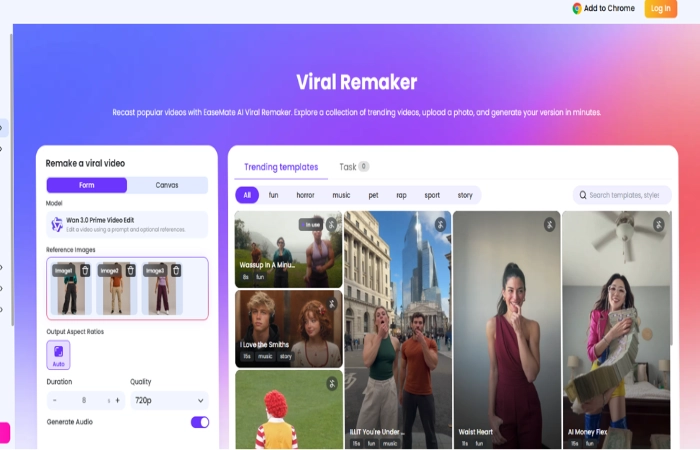
This is where EaseMate AI fits seamlessly into a modern creator’s toolkit. Beyond standard video-to-video style transfers, its Viral Video Remaker feature lets you recast proven, high-performing social media video trends using your own brand assets, hosts, or product visuals. Instead of filming new skits or complex transitions from scratch, you can:
- Select a Trending Format: Browse EaseMate AI’s library of viral short-form templates (ranging from dynamic camera transitions and cinematic scenes to popular social challenges).
- Upload Your Subject or Product Image: Drop in a clear photo of your podcast host, mascot, or product.
- Generate Trend-Aligned Visuals: EaseMate AI maps the motion, pacing, and visual rhythm of the viral reference onto your subject.
Using EaseMate AI’s Viral Video Remaker to create eye-catching 3-to-5-second intro hooks or visual cutaways bridges the gap between deep long-form educational audio and the fast-paced visual aesthetics that TikTok and Reels algorithms favor.
Step 4: Native Metadata & Cross-Platform Optimization
Never cross-post identical files with competing watermarks. Before scheduling your batch across platforms, tailor the metadata so both human viewers and AI indexing bots understand the context:
- TikTok: Front-load spoken and on-screen keywords in the first 3 seconds; write descriptive 2–3 sentence captions optimized for TikTok Search.
- Instagram Reels: Focus on shareability (“Send this to a founder who…”) and keep text overlays within the central 4:5 grid safe zone so profile previews look clean.
- YouTube Shorts: Use clear, curiosity-driven titles (under 50 characters) and link the Short directly back to the full-length source video using YouTube’s Related Video feature to drive long-form session watch time.
Platform-by-Platform Formatting Specs (2026 Quick Reference)
| Feature / Metric | TikTok | Instagram Reels | YouTube Shorts |
| Optimal Aspect Ratio | 9:16 (1080 x 1920) | 9:16 (1080 x 1920) | 9:16 (1080 x 1920) |
| Ideal Viral Length | 21 – 45 seconds | 15 – 35 seconds | 30 – 58 seconds |
| Primary Ranking Signal | Completion rate & search keywords | Sends (DM shares) & replays | Viewed-vs-swiped ratio & retention |
| Best Visual Hook Style | Fast cuts, trend remakes, bold text | Aesthetic transitions, relatable POVs | High-clarity value propositions |
| Long-Form Funnel | Profile link / Series playlist | Comment-to-DM automation | Native “Related Video” link |
Common Repurposing Mistakes That Kill Retention
- Leaving “Dead Air” Between Sentences: Long-form conversations naturally include pauses, filler words (“um,” “you know”), and slow transitions. Tighten cuts so there is zero breath gap between sentences.
- Ignoring Visual Pacing: If a clip runs longer than 15 seconds without a camera angle change, B-roll overlay, zoom punch-in, or AI-remade visual cutaway, retention drops sharply.
- Generic AI Captions: Auto-generated captions with spelling errors destroy viewer credibility. Always proofread brand names, technical terms, and numbers.
Frequently Asked Questions (FAQ)
How many short-form clips should I extract from one long video?
A well-structured 30-to-60-minute podcast or YouTube video typically yields 8 to 15 high-quality vertical clips. Focus on extracting complete, standalone insights rather than forcing a higher volume of weak, context-dependent clips.
How can I make talking-head clips look more engaging without hiring a motion designer?
Combine tight jump cuts with generative visual tools. For example, you can use EaseMate AI’s Viral Video Remaker to transform static photos of your host or product into dynamic, trend-inspired video clips, giving your talking-head segments high-energy visual hooks without manual animation or extra filming.
Should I post the same short-form video to TikTok, Reels, and Shorts on the same day?
Yes, publishing across all three platforms within a 24-hour window is standard practice in 2026. Just ensure you export clean, watermark-free master files and customize the headline text and caption keywords to match each platform’s search behavior.
