
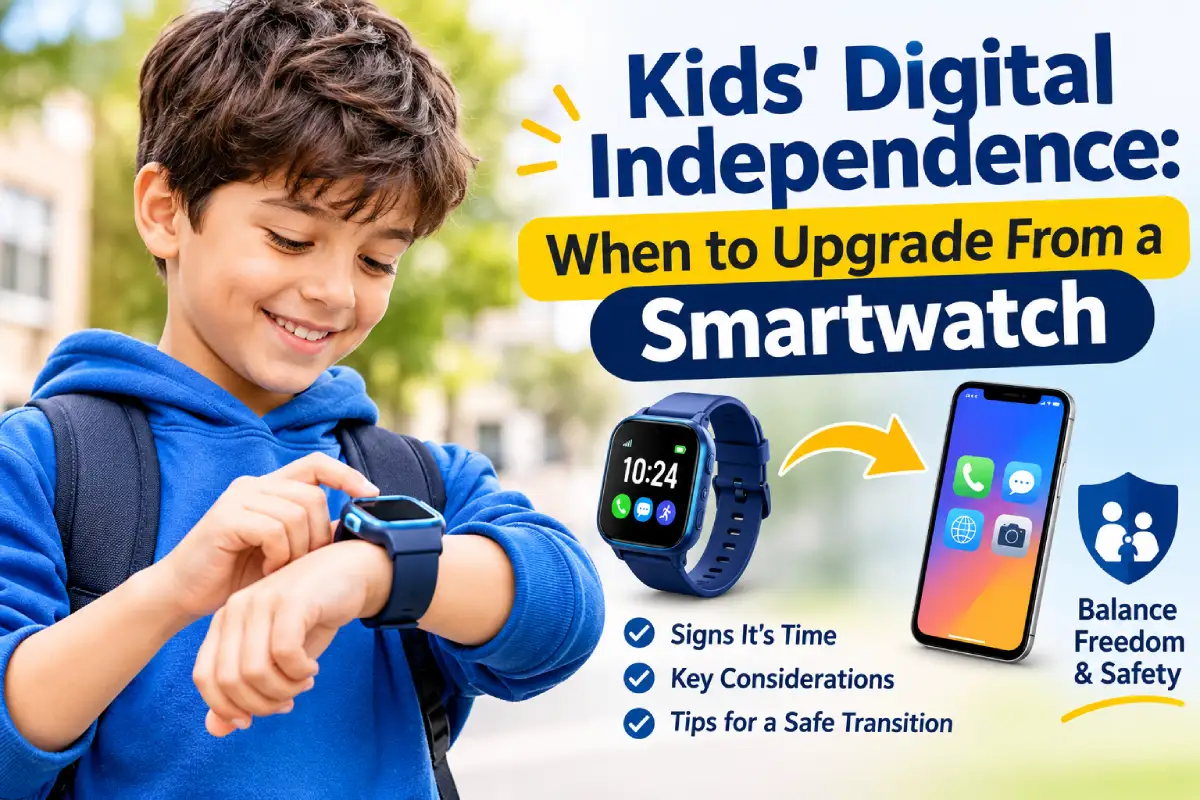
Most kids get their first smartwatch somewhere around Year 1 or 2 at primary school. It feels like the perfect middle ground. They get a taste of freedom, and you can still see where they are.
Then, a few years later, the question lands: “Can I get a phone?” Every parent hits this moment eventually, often sooner than expected.
A lot of families start this journey with options like Spacetalk Kids Smartwatches, which pair location awareness with a closed, parent-approved contact list, well before any phone enters the picture.
Table of Contents
How Do You Know They’re Ready?
There’s no single birthday that makes a kid ready for a phone. Readiness shows up in behaviour, not age.
Three things matter more than candles on a cake. How well does your kid handle responsibility? How sound is their judgement under pressure? How openly do they talk to you about problems? A ten-year-old who scores well on all three is often more ready than a thirteen-year-old who scores well on none.
Age is a rough guide at best. Treat it as a starting point for the conversation, not the deciding factor.
The Cost of Getting the Timing Wrong
Jumping too early and waiting too long both carry a cost. They’re just different costs. Upgrade before your kid’s ready, and you risk:
- unsupervised access to group chats and social apps they don’t yet have the judgement to navigate.
- content with no filter in place, stumbled on rather than sought out.
- a device that gets lost, cracked, left on a bus or forgotten at a friend’s place.
- a kid who feels responsible for something bigger than they can actually manage.
Wait too long past the point they’re genuinely ready, and the risks flip. Kids borrow friends’ phones to do what they’re curious about anyway, just without you in the loop. Trust erodes on both sides. Aim to time the handover to their actual readiness, not to a fixed age or to what their friends have.
Three Readiness Indicators Worth Watching
Forget the birthday. Watch these three things instead.
Indicator 1: Responsibility
A smartwatch is nearly impossible to lose; it’s strapped to their wrist the whole day. A phone sits loose in a bag, a pocket, a locker or a classroom tray, and that’s a real test. Before handing over a phone, look for evidence of:
- keeping their smartwatch, lunchbox, hat and school gear together without daily reminders.
- returning home or checking in at the time they agreed to.
- charging their own devices without being told.
- following through on small jobs, like feeding a pet or packing their own bag, without supervision.
Indicator 2: Maturity
Maturity here isn’t about being quiet or well-behaved. It’s about whether they pause before acting and understand that actions have consequences. Signs worth looking for:
- pausing to think before firing back a message when they’re upset.
- understanding why a password shouldn’t be shared, even with a best friend.
- telling the difference between a joke and something that could actually hurt someone.
- apologising on their own once they realise they’ve upset somebody.
Indicator 3: Communication
This is the indicator parents underrate most. A kid who tells you when something feels off online is far safer with a phone than one who stays quiet and hopes it blows over.
Watch for whether they come to you, unprompted, about a mean message, an app a friend showed them, a stranger’s comment or something confusing they saw. That instinct to loop you in matters more than any parental control setting ever will.
The Progression Plan: A Realistic Timeline
Digital independence isn’t a light switch. It’s a staged handover, and most families move through it over several years.
Phase 1: Smartwatch Only
Phase 1 usually runs from about five to ten years old. It’s built around devices like Spacetalk Kids Smartwatches, which offer calling, messaging, safe zone alerts and an SOS button, without opening up the internet, social media, an app store or outside games.
At this stage, your kid gets a taste of independence, walking to a friend’s house, catching a bus, staying back for after-school care or heading to training on their own, while you still see where they are and who they can talk to.
Phase 2: Smartwatch Plus a Limited Phone
Somewhere around ten to twelve, some families add a basic phone alongside the smartwatch, rather than replacing it outright. Think calls and texts, full stop. No app store, no browser, no social media feed, no open internet.
This phase is about practising charging the phone, not losing it, keeping the screen intact and answering when you call, while the smartwatch still handles location and emergency contact.
Phase 3: A Phone With Parental Controls
By the early teens, many kids move to a full smartphone, but one with real limits set from day one: app approval required, screen time windows, content filters and location sharing switched on.
The phone replaces the watch for day-to-day contact, but the controls do the job the watch used to do.
Phase 4: Graduated Independence
Controls loosen gradually, not all at once, usually tied to how well your kid has handled each previous phase.
A fifteen-year-old who’s shown good judgement for two years earns more latitude than one who’s had three strikes on screen time.
This phase can run well into the late teens. There’s no fixed finish line, just steadily less oversight as trust builds.
Five Red Flags That Say Not Yet
Some signs point clearly to holding off, whatever the calendar says.
Red Flag 1: They Lose Things Constantly
If hats, water bottles, library books and jumpers go missing on a weekly basis, a phone will go the same way, just at a much higher cost to replace.
Red Flag 2: They’re Sneaky About What They Do Online
A kid who closes a tab the second you walk in, or clears search history on a shared device, is telling you something. That instinct to hide activity is a bigger concern than any single thing they might be hiding.
Red Flag 3: They Cave to Peer Pressure Easily
If “everyone else is doing it” reliably overrides their own judgement at school or with friends, the same pattern will play out in group chats and on social apps, just with less of your oversight.
Red Flag 4: They Melt Down Over Boundaries
Screen time limits, bedtime cut-offs, app restrictions and device-free dinners all require a kid to accept a “no” without a full-scale protest. If that’s currently a daily battle, adding a phone adds more boundaries to fight over, not fewer.
Red Flag 5: They Can’t Own Up to Mistakes
A kid who blames someone else, denies it outright, hides evidence or insists it wasn’t their fault will handle a phone mistake the same way: a nasty message sent in anger or something downloaded by accident. Owning mistakes is what lets you help before small issues become big ones.
Upgrade Options, If They’re Ready
If the readiness indicators stack up, here’s how families typically handle the next step.
Option A: Stay With the Smartwatch a Bit Longer
If every readiness indicator points to “not quite yet,” staying with Spacetalk Kids Smartwatches for another six to twelve months costs nothing. It gives your kid more time to grow into the next stage. There’s no prize for upgrading early.
Option B: Add a Basic Phone
A phone with calls and texts only, no app store, no browser, no social media and no open internet, is a low-stakes way to practise phone responsibility while the smartwatch still covers location and emergencies. It’s the middle rung on the ladder, not a leap.
Option C: Jump Straight to a Smartphone
For an older tween or young teen who’s ticked every readiness box, a smartphone with app approval, screen time limits, content filters and location sharing switched on from day one can work. Set every control up before handover, not after something goes wrong.
Closing Thoughts
The upgrade from a smartwatch to a phone should follow your kid’s readiness, not their age, their friend group, a quiet Saturday that happens to suit you or what everyone else is doing.
Base the call on how your kid handles responsibility. Layer in how mature their judgement is and how openly they communicate, and you’ve got a real answer. Use the progression plan to stage the handover instead of jumping straight to a full smartphone.
Whether that means sticking with Spacetalk Kids Smartwatches for longer or moving to a basic phone with firm limits, the goal stays the same: freedom that grows at your kid’s pace, not the calendar’s.
Also Read: Ultimate 2026 SEO Guide: Instant Gaming
